
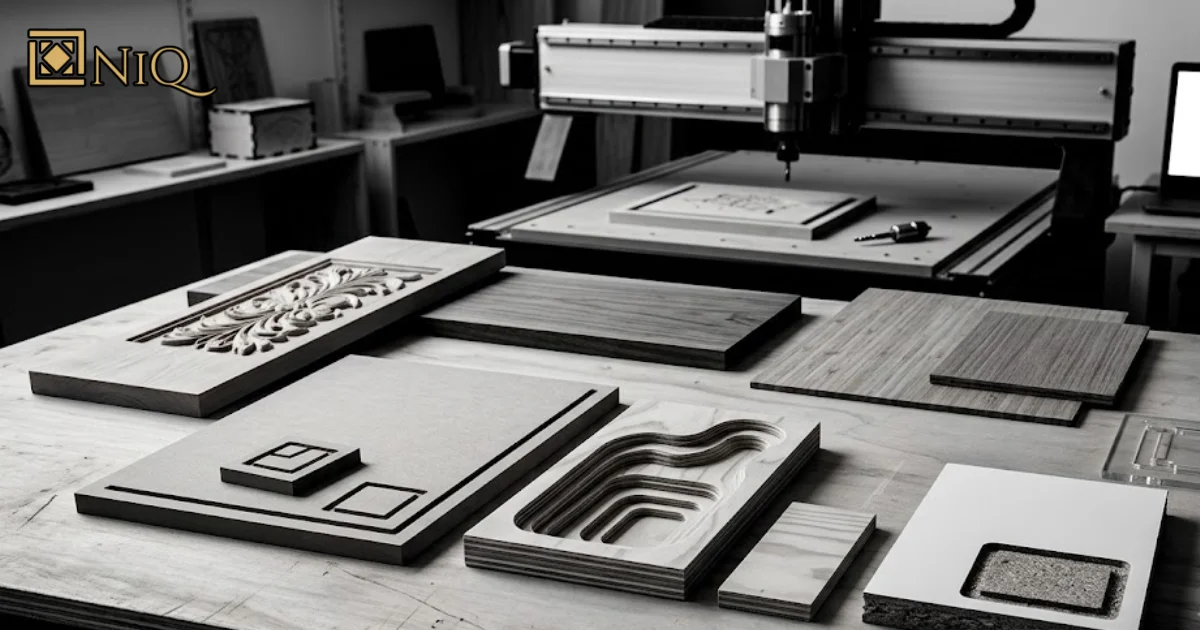

Choosing the right material is one of the most important decisions in any furniture or interior project. While CNC machines can cut a wide range of wood-based panels with exceptional precision, each material offers different characteristics, strengths, and applications. Selecting the appropriate board not only affects the appearance of the finished product but also its durability, cost, and overall performance.
Whether you’re manufacturing kitchen cabinets, wardrobes, office furniture, shelving, or custom interior fixtures, understanding the most commonly used CNC wood cutting materials will help you make the right choice for your project.
Why Material Selection Matters
CNC cutting delivers accurate, repeatable results regardless of the material being processed. However, different wood panels vary in density, strength, moisture resistance, surface finish, and machining characteristics.
The right material depends on several factors, including:
- Intended application
- Budget
- Required strength
- Surface finish
- Moisture exposure
- Weight requirements
- Decorative appearance
Choosing the right board ensures better machining performance, improved durability, and a higher-quality finished product.
MDF (Medium Density Fiberboard)
MDF is one of the most widely used materials in CNC furniture manufacturing. It is made by compressing fine wood fibers with resin under high pressure to create a dense, smooth panel.
Its uniform structure makes it ideal for CNC machining because it produces clean cuts, sharp edges, and detailed profiles without splintering.
Benefits of MDF
- Smooth and consistent surface
- Excellent machining performance
- Ideal for painting and laminating
- Easy to cut and route
- Cost-effective for furniture production
- Suitable for intricate CNC designs
Common Applications
- Kitchen cabinets
- Wardrobes
- TV units
- Decorative wall panels
- Office furniture
- Interior shelving
- CNC carving and engraving
Plywood
Plywood is manufactured by bonding multiple thin layers of wood veneer together with alternating grain directions. This construction gives plywood excellent strength, durability, and dimensional stability.
Compared to MDF, plywood offers greater structural strength while remaining relatively lightweight.
Benefits of Plywood
- High strength-to-weight ratio
- Excellent durability
- Better screw-holding capability
- Good moisture resistance (depending on grade)
- Suitable for heavy-duty furniture
- Long service life
Common Applications
- Cabinet construction
- Furniture frames
- Doors
- Shelving
- Interior partitions
- Commercial furniture
- Structural furniture components
Particle Board
Particle board is manufactured from wood chips and sawdust bonded together using resin. It is an economical option commonly used in furniture manufacturing where cost is an important consideration.
Although it is not as strong as plywood, particle board performs well for many indoor furniture applications when properly finished and edge banded.
Benefits of Particle Board
- Budget-friendly
- Lightweight
- Smooth surface for laminates
- Easy to machine using CNC
- Suitable for mass production
- Available in various thicknesses
Common Applications
- Office furniture
- Storage cabinets
- Wardrobes
- Shelving units
- Ready-to-assemble furniture
- Residential furniture
Melamine Boards
Melamine boards consist of MDF or particle board covered with a decorative melamine surface. They are widely used because they offer an attractive finish without requiring painting.
The hard decorative surface also improves scratch resistance and simplifies cleaning.
Benefits of Melamine Boards
- Ready-to-use decorative finish
- Wide variety of colors and textures
- Scratch-resistant surface
- Easy to clean
- Low maintenance
- Ideal for modern interiors
Common Applications
- Kitchen cabinets
- Office furniture
- Retail displays
- Wardrobes
- Shelving
- Interior storage systems
Laminated Boards
Laminated boards feature a durable laminate layer bonded to the panel surface. They provide improved resistance to wear, moisture, and daily use while offering countless decorative options.
These panels are commonly used in residential and commercial furniture projects.
Benefits of Laminated Boards
- Attractive decorative finishes
- Improved durability
- Moisture-resistant surface
- Easy maintenance
- Suitable for high-traffic areas
- Long-lasting appearance
Common Applications
- Modular kitchens
- Commercial furniture
- Reception counters
- Retail fixtures
- Hotel furniture
- Office workstations
HDF (High Density Fiberboard)
HDF is similar to MDF but has a higher density, making it stronger and more durable. It offers a smooth finish while providing greater resistance to impact and wear.
Its dense structure allows for precise CNC machining and excellent finishing results.
Benefits of HDF
- Higher density and strength
- Smooth surface quality
- Better durability
- Excellent machining accuracy
- Suitable for detailed designs
- Long-lasting performance
Common Applications
- Premium furniture
- Decorative panels
- Interior wall features
- Cabinet components
- High-quality shelving
Veneered Panels
Veneered panels combine an engineered wood core with a layer of natural wood veneer, offering the appearance of solid wood while reducing cost and improving stability.
These panels are often selected for luxury furniture and high-end interior projects.
Benefits of Veneered Panels
- Natural wood appearance
- Elegant finish
- Better dimensional stability than solid wood
- Suitable for polishing and staining
- Premium aesthetic appeal
Common Applications
- Executive office furniture
- Luxury cabinets
- Hotel interiors
- Decorative wall panels
- Premium residential furniture
Which Material Is Best for CNC Cutting?
There is no single material that suits every project. The ideal choice depends on your specific requirements.
- MDF is best for painted furniture, decorative panels, and intricate CNC machining.
- Plywood is ideal for strong, durable furniture and structural applications.
- Particle Board offers an economical solution for budget-friendly furniture.
- Melamine Boards are perfect for ready-finished cabinets and wardrobes.
- Laminated Boards provide durability and decorative appeal for modern interiors.
- HDF is suitable for premium-quality furniture requiring greater strength.
- Veneered Panels are the preferred choice when a natural wood finish is desired.
Why CNC Machines Work Well with These Materials
Modern CNC machines are capable of cutting, routing, drilling, grooving, and shaping all of these materials with exceptional precision. Computer-controlled machining ensures accurate dimensions, smooth edges, and consistent quality regardless of the panel type.
Combined with services such as edge banding and precision finishing, CNC machining helps transform raw panels into high-quality furniture components ready for assembly.
Conclusion
The success of any furniture or interior project starts with choosing the right material. MDF, plywood, particle board, melamine boards, laminated boards, HDF, and veneered panels each offer unique advantages depending on the application, budget, and desired finish.
When paired with professional CNC wood cutting services, these materials can be transformed into precise, durable, and high-quality components for residential, commercial, and custom furniture projects. Understanding the strengths of each material helps ensure better performance, improved efficiency, and outstanding results in every project.